


Gratis e-book
Checklist 100 punten Bedrijfsverhuizing



12 tips for a structured move
From facility manager of a combined school
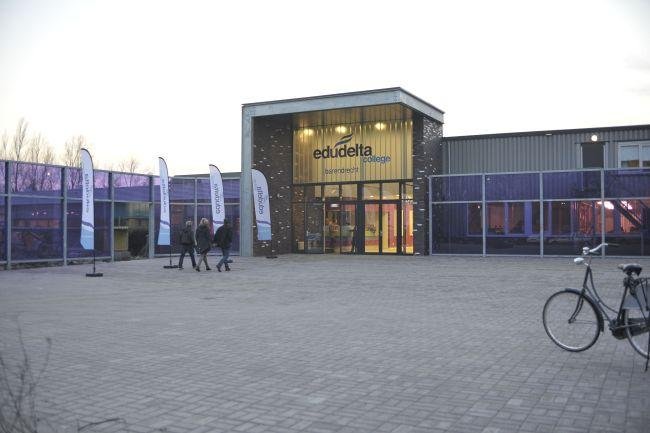
The educational institution Edudelta College in Barendrecht closed one of its branches. Students and teachers moved to the main location, which was expanded considerably.
After the move, Facility Manager Angela Heijboer wrote a positive review about De Haan Project Movers.
'I have experienced a great cooperation with you yesterday and today under the direction of Skip! Our mbo college was moved smoothly and quickly to the new location! #Thanks'
A good reason to ask her how she handled the move.
Heijboer is enthusiastic: Overseeing a move is a matter of logical thinking and planning ahead. It does make a difference that it was not my first move and that the relationship with my colleagues at Edudelta College is very good. Together you can achieve a lot if you listen to each other and let people think along.'
Angela Heijboer gives 12 tips for a structured move.
1. Know the building
The relocation of Edudelta College was originally planned one school year earlier. This allowed more time to prepare the move properly. 'Then all of a sudden you have time left and you can prepare things properly. It is important that you know the building well, right down to the last piece of furniture. Once you've mapped everything out, you can start coordinating, assigning spaces to employees to prepare for relocation and make a schedule. Then you know exactly what you are talking about.'
2. Communicate with colleagues
Waiting until the last moment is almost never a good idea, especially when it comes to internal communication. 'The most important thing is to communicate early on what is expected. I regularly attended the meetings with concierges and the teaching team. Just sending a letter with the announcement is not enough,' Heijboer explains. ‘You should also give people the opportunity to ask questions and make suggestions. To say something in return. For this reason, it is advisable to include the move as an agenda item in the work meetings well in advance. It is important to get everyone on board. Moving our school has thus become real teamwork. You also need to monitor whether everything that is agreed is being done.'
3. Strategically determine the date of the move
‘Of course, I immediately checked when the concierges were available. They are really important during the move. The move was planned in the first week of the school holidays, when the concierges are still at work. I fitted them in to the schedule to assist at the new location. Should anything in the plans be changed unexpectedly, I would have enough time left before the end of the summer holidays and before the lessons would start.'
Once the removal date has been determined, the preparations can begin. Angela Heijboer: 'Of course you have to prepare. Only after classifying the spaces at the new location and making a sticker plan, you can really start clearing up and labelling the boxes.'
4. Clear up!
In fact, for an organization moving means that some serious clearing up is required. ‘Teachers do not have much time and many other tasks. This applies, of course, to most employees in a company. That's why it's important to offer support,' Heijboer says from experience. 'In our case, the concierges could take on a major role here. If they do a lot of clearing, the teachers also see that they are not alone. A move is something you really have to do together.'
But concierges also have their regular work. That's why Angela Heijboer has provided space in the planning: 'In the calendar I look at when the teachers and concierges have time and then I plan well in advance when and what will be cleared up. I assigned the general areas to colleagues. I made them responsible for making that part of the building “ready to move”. Then I explained how to actually prepare such a space. You can't simply say: “Pack your things and empty the classroom”. You have to communicate well in advance and gradually and take into account the workload of your colleagues.'
5. Waste processing
The clearing-up process is guaranteed to generate waste. 'I want teachers and concierges to have as few things in their hands as possible. So, if they pick something up, it must either be packed or disposed of immediately. As a coordinator, you have to make sure that these two choices are also available: dispose of or pack. It is therefore important to have containers installed in good time. If waste cannot be disposed of immediately, the waste pile will accumulate. That does not motivate the team to go and clear up. Also make proper arrangements with the waste collector. It is better to have a container delivered one day early than half a day late. The team must remain motivated and a smooth waste processing is part of that'.
6. Sufficient packaging material
There is so much more packaging material available than just folding boxes. 'Time' also plays an important role here. Heijboer: 'Make sure that the moving company delivers boxes in good time, for an early start with packing. Every time a teacher has some time, he or she can sort out a few metres. The temptation to take things with you should be as small as possible, so the containers for the waste should always be close at hand.’
7. Sticker plan and floor plans
‘I made the sticker plan myself. Just like all other steps, this had to be done well in advance, so that the teachers could label their boxes with the right stickers. I used the floor plans of the new building for this purpose. For each space I drew in the occupant. I used markers in the same colours as the removal stickers. I also numbered the rooms. One day before the move, I hung the signposting in the new building myself. Again, I applied the colours and numbers and hung them clearly visible on the door so the movers did not have to find their way. This made logistics run very smoothly.'
8. Good structure, less to move
‘If you create the right structure, you will see that there will ultimately be considerably less to move. Take our company archive as an example. This was sorted out well in advance, which meant that a confidential flow of paper had to be disposed of. We could destroy 75% of the archive, so we only had to move 25%. Then you can ask the removal company for a new quotation for that part of the move. You can also reserve less space for the archive at the new location. Much more efficient.’
9. The day of the move
‘During the move I coordinated at the old location. I wanted to move as efficiently as possible and be able to close the doors as quickly as possible after the move. After that, you can focus fully on the new location. The concierges were present at the new location. Because we had good lines of communication, they knew what had to be done there.’
10. The first working day after the move
A few weeks after the move, the teachers arrived at the new workplace. 'We had already divided up the workstations beforehand and made sure that not only the boxes were in the correct rooms, but also the right boxes were at the right desks. It is nice for employees when everything is organized. That motivates them to quickly unpack the boxes because the boxes eventually have to be returned to the removal company. If the facilities department ensures that the preconditions are in order, the employees will also cooperate with more pleasure.'
11. Take digitalization steps
'For our school, the move was a good opportunity to cancel long-term contracts or close better deals. Once someone determined how many printers are needed, but is that still the case? After the move we reduced the number of printers. I also looked critically at franking machines with their subscriptions and at the fax machines. A relocation is a good opportunity to take a digitalization step. Simply look at your organization with a critical eye'.
12. ICT and logistics
Until now Heijboer has shared tips for moving things, but a lot also needs to be done in other fields. ‘I could make a new 12-step plan for this,' she says, laughing. ‘The whole ICT had to be moved and therefore the server room had to be dismantled. But don't forget to cancel all kinds of contracts, subscriptions and utilities either. You have to steer all that in the right direction too'.
Any questions? Our experienced specialist is at your service.
You can reach me at +31 78 69 20 303 or send an email.